
Every year, the number of deer hunters increases. This isn't a bad thing since the number of deer is also increasing rapidly and state game commissions do a good job of controlling the hunt. However, beginning hunters often don't understand some of the terminology that is used in regard to deer. For that matter, quite a few people who've been deer hunting many times also don't understand some of the terminology. Here is the ultimate guide to those hunting terms and what they mean.
A
AIR WASHED AKA WIND WASHED
This term refers to when a bird fly's, its scent is undetectable once it has landed, due to the wind and the air washing the scent away.
B
BEAM
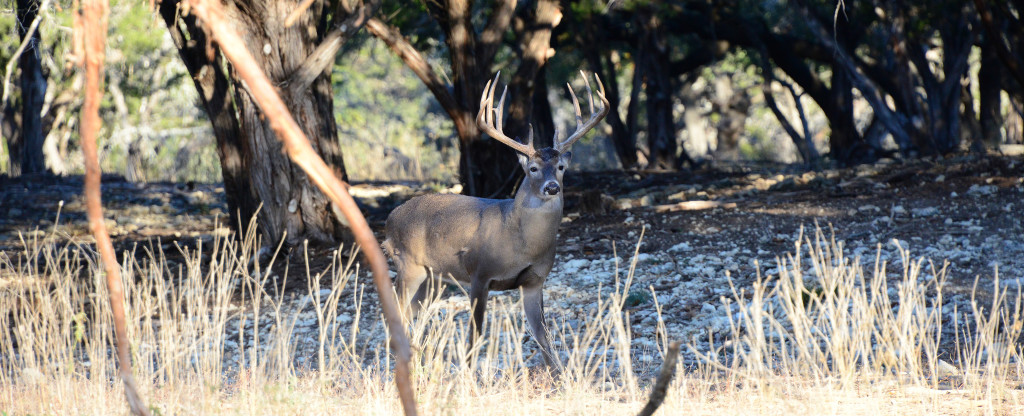
The beam is the main antler of the buck. From the beam, the other points, called "tines" fork out. A spike has no tines on either side, but all others have more tines than beams.
BEDDING AREAS
This is where deer lay down to rest/sleep, seek shelter from harsh weather or to hide from predators. Ideal bedding areas for deer are thickets, blow downs and brush. Take a look at this video to see what some deer bedding areas may look like:
BENCH LEG
Mule deer and Blacktail deer are different species, but they can interbreed in areas where their ranges overlap. A bench leg is the result of such interbreeding. It is neither a mule deer nor a black tail, but has traits of both.
BLEAT
A doe or fawn grunt call. Doe bleats work best starting at the end of pre-rut going through after the rut because this is when bucks are looking to breed with a doe. Fawn bleats are great all season round.
BLOW DOWN
An area of trees or branches from trees which have been blown down from heavy winds. This is a common bedding area for deer. Blow downs can also be used or created by hunters as camouflage from deer.
BOW HUNTING
Hunting small or large game using archery equipment (a bow and arrow). Bow's commonly used are the tradional (recurve) style or compound bows.
BRACE
2 dogs bird hunting at the same time in the same area.
C
CALIBER
When talking firearms the caliber refers to the measurement of the diameter of the projectile being fired or the diameter of the barrel itself.
CANNON NETTING
Large nets which cover a determined area and are propelled with the force of explosive projectiles. Usually used to catch a large amount of animals (eg birds) but also used as a method for trapping. See it in action:
CENTERFIRE
Centerfire ammunition are cartridges that have a self contained primer in the back of the cartridge. For a detailed description of how they work check out our Rimfire vs Centerfire article.
CHECKERING
Checkering is a form of patterning (in diamond shapes) a gun/rifle stock. The are mostly done on the grip or fore-end of a rifle or shotgun and on the grips of a handgun.
It's been around for over a hundred years, and in its earliest forms was done in the patterns of squares.
See checkering in action:
CLIMBING TREE STAND
A climbing tree stand is just one type of tree stand used to hunt out of. It works by binding on to the trunk of a tree creating a wedge that is held by the weight of the hunter. The hunter can then sit and climb up the tree.
See the best climbing tree stands and how they work here.
E
EYE GUARD
It has been mentioned that the eye guards weren't counted as antler points. This doesn't make sense if you don't know what eye guards are. An eye guard is simply a horn that branches generally forward, not far from the buck's forehead. Basically, it is the first point on the antler and all bucks have them, if they have antlers.
F
FAWN
A fawn is a baby or young deer
FIELD DRESSING
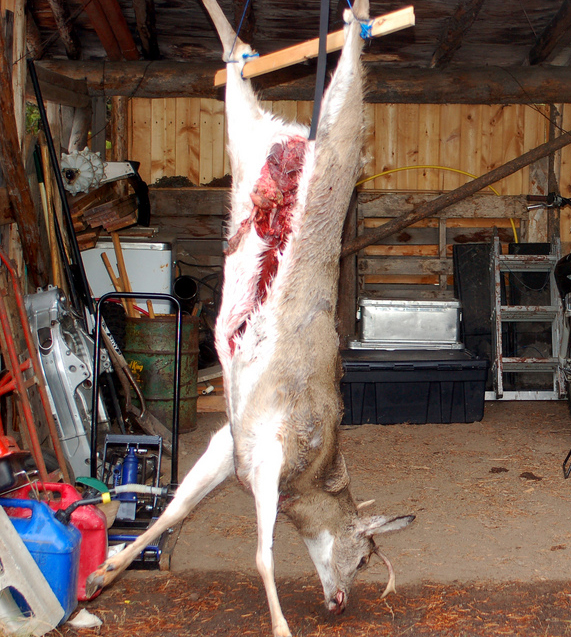
Field dressing (also referred to as "gutting") is the process of removing the internal organs of the game that has just been harvested. The process can involve a few steps and requires specific tools such as a sharp knife. Some of these steps may involve skinning the game, which again would require specialised equipment such as a skinning knife.
Field dressing is done in order to be able to preserve the game's meat (venison for example) and must be done quickly (usually straight after the game is killed and while still out in the field) hence why it is called "field" dressing.
For more information check out our guide on "How to process a deer" from start to finish which includes field dressing.
The below video is just an example of one way that field dressing a deer can be done. WARNING: This video is graphic.
FOOD PLOT (AKA DEER PLOT)
A food plot is essentially a source of food which is planted by hunters to feed deer. Food plots can be used as bait to attract deer or purely just to feed deer something nutritious.
FOUR POINT BUCK (4-POINT BUCK)
This term is a reference to the number of antler tips, not counting the eye guard. The buck can be said to be a 3-point, 4-point or whatever. There can be some confusion, though. In some parts of the country, mostly in the west, only the antler tips on the side that has the most points is counted, while in other places, primarily in the east, all the points are counted. Thus, a 4-point could refer to a deer that has two points on each side or one that has four points on one side.
To get around this and make it understandable to hunters everywhere, many hunters may refer to a deer as being a four by three, written 4x3, for instance. This means that the buck has four points on one side and three on the other. Incidentally, note that nothing was mentioned about deer that are 1-point or 2-point bucks. There is special terminology for these. If a buck only has a single point on each side, they are called a "spike". If they have two points on each side, they are forked horns or "forkies".
FRICTION CALL
A type of caller that can come in many different shapes and sizes. Some of the common surfaces of friction calls are glass, crystal, and slate. They also come with different kind of strikers such as wood or waterproof. They require stoning and sanding.
They work slightly different to other calls, in that it creates the sound of the call by rubbing the striker across the grain on the surface. This video will show you how a friction call is used:
G
GUNSMITH
A gunsmith is a person who makes, sells, and repairs firearms. A gunsmith is responsible for ballistics, design, engraving, refinishing, and repair & maintenance of firearms.
Services offered by gunsmiths can vary and include (but are not limited to):
- Accurizing
- Checkering
- Bluing
- Browning
- Stockmaking
- Parkerization
H
HARVEST
When used in hunting terms harvest or harvesting relates to "taking" or "killing" of an animal for the meat/food, or for controlling the overpopulation.
HITTING POWER
Hitting power is the terminology used to describe how hard a bullet hits the deer. Usually this is a combination of the speed of the bullet and its weight. High hitting power, like that provided with a .300 magnum with 180 grain bullets, will usually knock a deer off its feet on impact. Low hitting power, like that of a .22 or .243, can leave the animal standing and ready to run or already running.
L
LICK
Also known as a deer lick is a place on the ground that is salty. Deer come to this spot to lick it.
M
MAST
Mast is a tree food source for deer.
O
OUTFITTER
Outfitter provide several services such as acting as guides for hunts and providing outdoor equipment, and accommodation.
P
PLINKING
A form of target shooting, where you shoot at objects such as tin cans or glass bottles. It is a more informal form of professional target shooting.
R
RED DOT SIGHT
Red dot sights are used to replace (or compliment) the standard iron sights on a firearm. There are a few different types of red dot sights including laser, holographic, and reflex. For a complete guide to how red dot sights work, and which are the best ones, click the following link:
S
STILL HUNTING
Still hunting is the act of hunting game on the ground. It involves stalking the prey through the woods in a very quiet and stealthy manner as opposed to hunting from a ground blind or tree stand.
V
VELVET
Every year, a buck loses its antlers and grows a new set. As they are growing, they are covered with a fuzzy and fleshy material that is packed with blood vessels to nourish the growing antler. This material is called the velvet. A reference to a buck in velvet simply means that the antlers are still covered with this material.
VENISON
Venison is the term used to describe the meat derived from any game from the deer family. See the benefits of eating venison over beef here.
This should give a new hunter a start for understanding what the words mean. One of the first steps in learning how to hunt deer is to learn the terminology that is used in this sport.